Reliable AI for Computational Pathology in the Era of Foundation Models (RECAP-FM)
Project PID2025-171570OB-I00: IA fiable para Patología Computacional en la Era de los Modelos Fundacionales
Introduction
Project PID2025-171570OB-I00 funded by
The RECAP-FM research team consists of doctors from the Visual Information Processing Group (VIP) at Universidad de Granada and Universidad de La Laguna , a doctor from Universidad de Córdoba, and expert pathologists from the Anatomic Pathology Unit from Hospital Universitario Clínico San Cecilio (HUSC), PhD students with extensive experience in the project theme, a doctor from the Northwestern University (Evanston, Illinois, USA), a doctor from the Institute for Artificial Intelligence in Medicine - Center for Computational Imaging and Signal Analytics in Medicine (Chicago, Illinois, USA), and a doctor from the University of Cambridge (UK).
This page will provide information on the project results and publications.
Summary

RECAP-FM (Reliable AI for Computational Pathology in the Era of Foundation Models) is a research project that aims to develop trustworthy artificial intelligence tools for cancer diagnosis using digital pathology images. Led by researchers from the University of Granada (UGR) in collaboration with pathologists from the San Cecilio University Hospital (HUSC), the project focuses on two representative cancer domains: prostate cancer and skin tumors.
Recent advances in foundation models have transformed computational pathology by enabling powerful image analysis with limited annotations. However, while these models achieve remarkable diagnostic accuracy, they often remain opaque "black boxes", making it difficult for clinicians to understand, trust, and safely deploy their recommendations. RECAP-FM addresses this challenge by placing reliability, uncertainty quantification, and interpretability at the center of AI development.
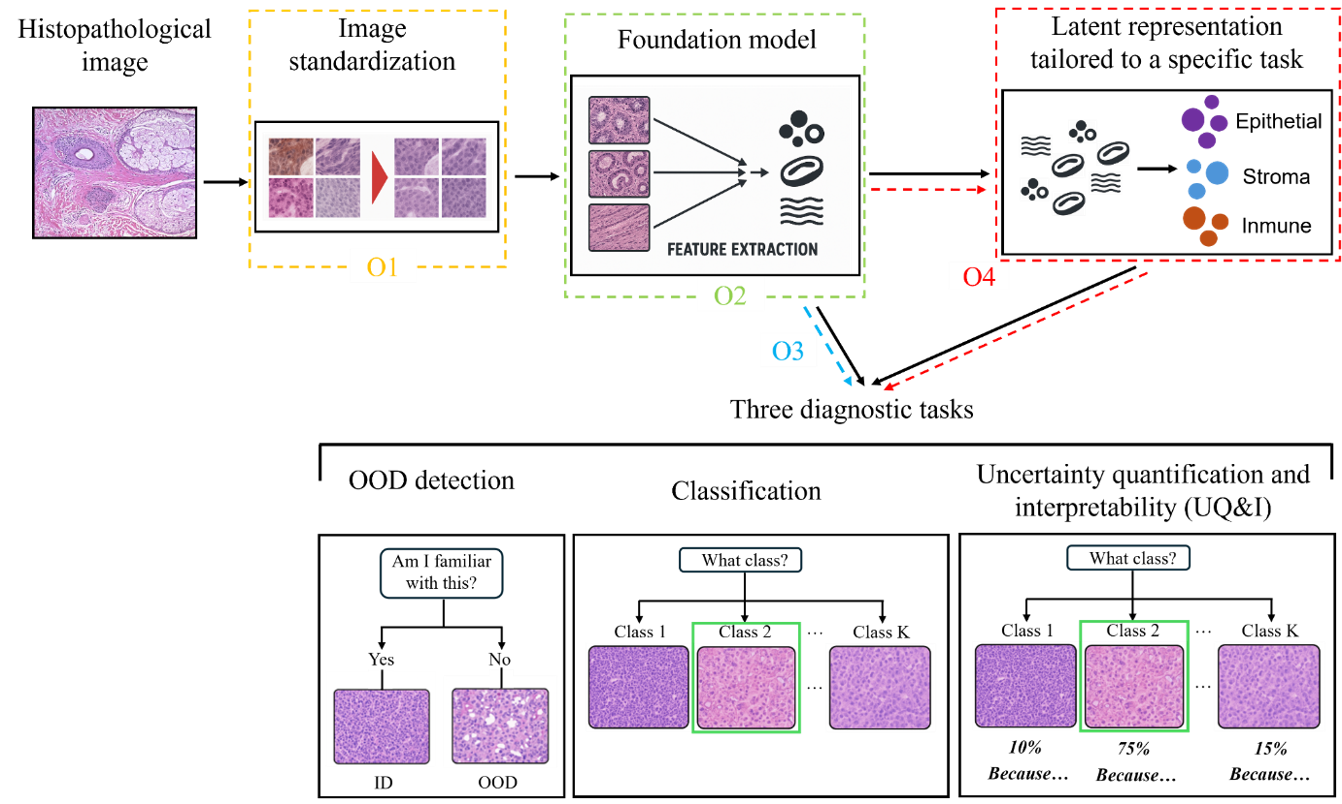
The project will develop new methods to improve histopathological image standardization, detect artifacts and out-of-distribution cases, and provide clinically meaningful explanations for AI predictions. By combining state-of-the-art pathology foundation models with probabilistic machine learning and generative AI techniques, RECAP-FM will create diagnostic systems capable of not only predicting disease but also estimating the confidence of their decisions and highlighting the image regions that support them.
A key feature of the project is its strong clinical orientation. All proposed methods will be designed and validated together with expert pathologists, ensuring that the developed technologies address real clinical needs and can be integrated into routine healthcare workflows. The project includes prospective validation studies to assess diagnostic performance, interpretability, and the impact of AI assistance on medical decision-making.
Through international collaborations with institutions such as Northwestern University and the Cambridge Centre for AI in Medicine, RECAP-FM seeks to advance the scientific foundations of reliable AI in healthcare and help bridge the gap between cutting-edge research and clinical practice. Its outcomes will contribute to more accurate, transparent, and trustworthy cancer diagnosis systems, supporting the future of precision medicine and AI-assisted healthcare.